The LED mask market is growing fast — but which features actually matter in 2026? Here's an honest, no-nonsense guide to help you choose wisely.
Every year, the shelves — physical and digital — fill up with new LED masks promising glowing, transformed skin. In 2026, the choice feels bigger than ever. But more options doesn't always mean better options. If you're searching for the best LED mask in 2026, the real question isn't which brand is trending: it's what actually makes an LED mask worth your money and your time.
What Makes the Best LED Mask in 2026?
The LED mask category has matured significantly. A few years ago, a single-colour panel with a handful of lights felt novel. Today, serious at-home devices are built around the same principles used in professional settings — multiple wavelengths, a meaningful number of LEDs, and clinically informed session protocols. Here's what to look for.
1. Number of LEDs: quantity and coverage
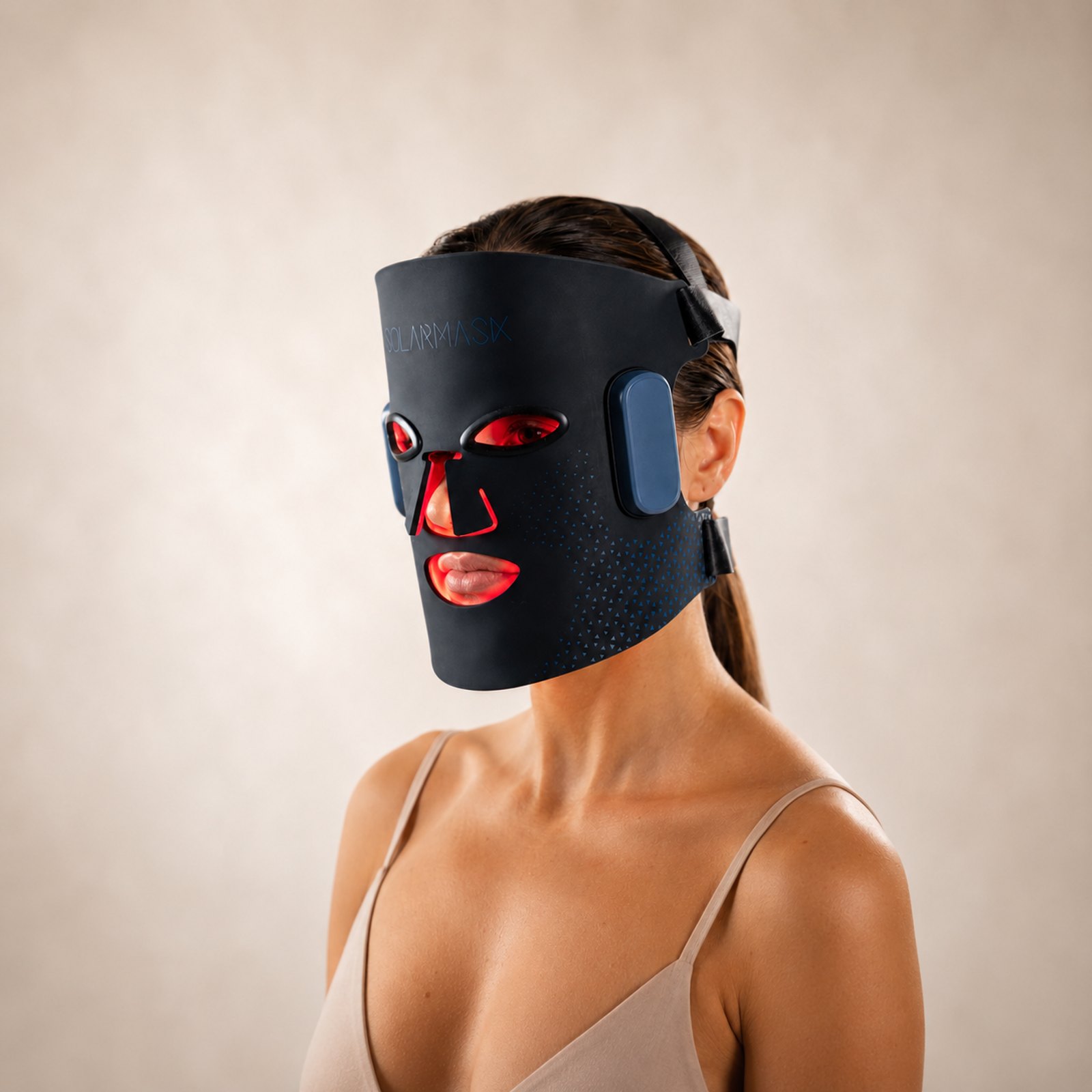
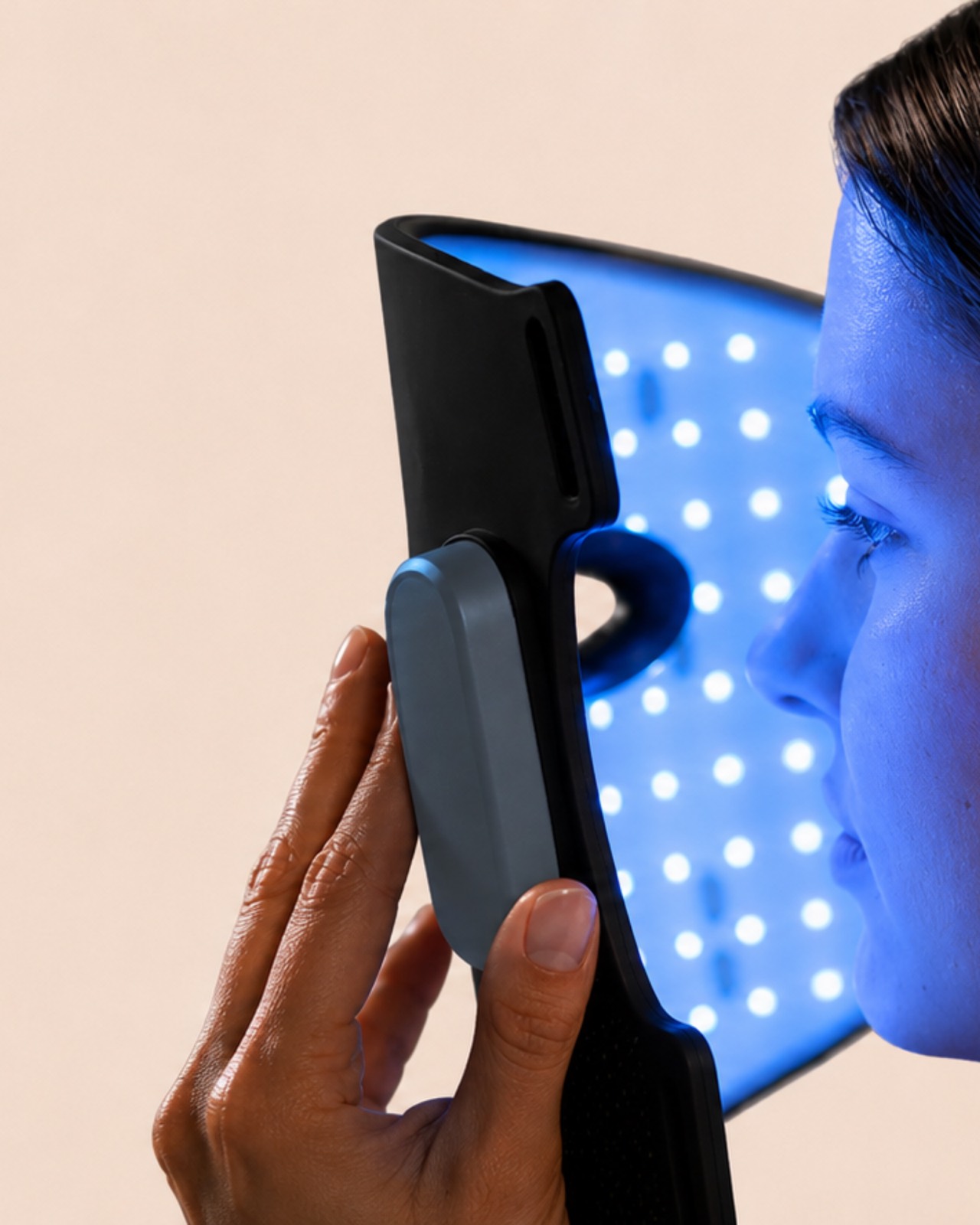
Coverage matters. A mask with too few LEDs leaves gaps in light delivery, meaning parts of your face receive little to no treatment per session. Look for devices with a high LED count that covers the full face — forehead, cheeks, chin, and the area around the nose and mouth. SolarMask, for example, features 312 LEDs distributed across the full facial surface, ensuring consistent light exposure across every zone.
2. Wavelengths: the science behind the colours
Not all light is created equal. Different wavelengths interact with the skin in different ways, and the best LED masks in 2026 don't limit you to one or two colours. The five wavelengths with the strongest body of supporting research are:
- Red (630 nm) — associated with supporting skin vitality and a more youthful-looking complexion. Learn more about red LED light therapy.
- Blue (450 nm) — studied for its effect on blemish-prone skin and surface clarity. Read about blue LED light therapy.
- Yellow (580 nm) — linked to a calmer, more even-toned appearance and reduced redness. More on yellow LED light therapy.
- Near-infrared (850 nm) — the deepest-penetrating wavelength, associated with recovery and skin resilience. Discover near-infrared therapy.
- Purple — a simultaneous combination of red (630 nm) and blue (450 nm), not a separate wavelength. It delivers the benefits of both colours in a single mode. More on purple LED light therapy.
A mask that offers all five of these in one device gives you genuine flexibility — you're not locked into one skin goal. That's the 5-in-1 principle that separates a truly versatile tool from a single-purpose gadget.
3. Safety credentials
In 2026, there is no excuse for an LED mask without proper safety certification. Look for CE certification as a baseline for the European market. Equally important: confirm the device emits zero UV radiation. UV has no place in a skincare light therapy device — any reputable mask will make this explicit. SolarMask is CE-certified and UV-free. If you'd like to go deeper on this topic, our article Zijn LED-maskers veilig? Wat de wetenschap zegt covers what the science currently says.
How to Use an LED Mask: Protocol and Consistency
Owning a good mask is only half the equation. How you use it determines what you experience. Research into photobiomodulation — the mechanism behind LED light therapy — consistently points to regularity as the key variable. A single session does very little; a sustained protocol is what builds visible results over time.
The SolarMask protocol: use the mask 3–5 times per week during the first 4–6 weeks. Each session lasts exactly 15 minutes — the device has a built-in automatic timer that stops the session for you, so there's nothing to track. After the initial period, most users move to a maintenance rhythm of 1–2 sessions per week. For more guidance on finding the right frequency for your skin, see Hoe vaak moet je een LED-masker gebruiken?.
Consistency over intensity — that's the principle. Missing the occasional session is fine; abandoning the routine after two weeks is where most people short-change themselves.
Value for Money: What Does €169 Actually Get You?
Professional LED light therapy facials in a salon or clinic typically cost between €50 and €150 per session. A course of six treatments — considered a reasonable starting point — can easily exceed €500. At-home devices offer a different proposition: a one-time investment that you use on your own schedule, at home, as many times as you need.
SolarMask is priced at €169. For that, you get 312 LEDs, five wavelengths, CE certification, UV-free light, and a fixed 15-minute auto-timer session — no subscriptions, no ongoing costs. Curious how the at-home experience compares to a professional salon treatment in more detail? We've broken it down in LED-masker thuis vs. de salon — wat is het verschil?.
- Look for at least five wavelengths: red, blue, yellow, near-infrared, and purple (red + blue combined).
- LED count matters — 312 LEDs ensures full-face coverage.
- CE certification and zero UV emission are non-negotiable safety benchmarks.
- Follow a consistent protocol: 3–5× per week for 4–6 weeks, then 1–2× per week for maintenance.
- Each session is exactly 15 minutes — the auto-timer does the counting for you.
- At €169, SolarMask offers professional-level specifications at a fraction of ongoing salon costs.
- Results vary from person to person — consistency is the single biggest factor.
What Users Are Experiencing
Numbers and specifications only tell part of the story. Many SolarMask users report a visibly brighter, more even complexion after the first few weeks of consistent use — a calmer, healthier-looking appearance that feels like a genuine upgrade to their skin's baseline. Results differ per person, and light therapy is not a substitute for medical advice. But the pattern across user reviews is encouraging: people who stick to the protocol tend to notice a difference.
If you use serums, retinol, or SPF as part of your routine — and in 2026, you really should be using SPF — understanding how to layer these alongside your LED sessions makes a meaningful difference to your results. Our guide on LED masks in your skincare routine walks through the optimal order step by step.
Veelgestelde vragen
Is the SolarMask safe for all skin types?+
LED light therapy is generally considered suitable for a wide range of skin types. However, if you are pregnant, taking photosensitising medication, or have a diagnosed skin condition, it's important to consult your doctor before starting any light therapy routine.
How long before I notice a difference?+
Most users begin to notice a visibly brighter, more even-looking complexion after 4–6 weeks of consistent use, following the recommended protocol of 3–5 sessions per week. Results vary from person to person.
Do I need to set a timer for my sessions?+
No. SolarMask has a built-in automatic timer that runs each session for exactly 15 minutes and then stops on its own. There's nothing to track or set manually.
What does 'purple' mean — is it a sixth wavelength?+
No. Purple is not a separate wavelength. It is a combined mode that activates red (630 nm) and blue (450 nm) LEDs simultaneously. SolarMask offers five distinct wavelengths in total: red, blue, yellow, near-infrared, and the purple combination.
Can I use an LED mask alongside my existing skincare products?+
Yes, and it's encouraged. Cleanse your skin before each session and apply your serums or moisturiser afterwards. If you use retinol or active acids, timing matters — our guide on LED masks in your skincare routine covers this in detail.
The best LED mask in 2026 isn't necessarily the most expensive or the most heavily marketed — it's the one with the right wavelengths, meaningful LED coverage, verified safety credentials, and a protocol you'll actually stick to. SolarMask ticks all of those boxes: 312 LEDs, five wavelengths (red, blue, yellow, near-infrared, and purple), CE certification, zero UV, and a simple 15-minute auto-timer session at €169. If you're ready to see what a consistent LED routine can do for your complexion, explore the SolarMask and find out for yourself.
Would you like to give this a go yourself?
The SolarMask LED Mask — all five wavelengths
Professional light therapy for home use. One mask, five treatments, 15 minutes per session. CE-certified.
View the mask →Esmee writes about skincare, LED light therapy and the science behind SolarMask. Any questions? Please email contact@solarmask.eu.
 Recommended by Dr. Farah MacDonald — physician & skin specialist
Sources & scientific studies
- Wunsch A, Matuschka K (2014). A controlled trial to determine the efficacy of red and near-infrared light treatment in patient satisfaction, reduction of fine lines, wrinkles, skin roughness, and intradermal collagen density increase. Photomedicine and Laser Surgery.
- Avci P et al. (2013). Low-level laser (light) therapy (LLLT) in skin: stimulating, healing, restoring. Seminars in Cutaneous Medicine and Surgery.
- Hamblin MR (2017). Mechanisms and mitochondrial redox signaling in photobiomodulation. Photochemistry and Photobiology.
- De Arruda Vidal C et al. (2020). LED phototherapy for facial rejuvenation. Journal of Cosmetic and Laser Therapy.
Medical disclaimer: This article is for informational purposes only and does not constitute medical advice. LED light therapy supports the skin but does not cure conditions; results vary from person to person. If you are pregnant, taking light-sensitive medication or have a skin condition, please consult your doctor first.