LED light therapy has been a staple in professional skin clinics for years — but at-home devices are closing the gap fast. So is an at-home LED mask genuinely comparable to a salon session, or is there a meaningful difference? Here's an honest look at both sides.
LED light therapy has been a staple in professional skin clinics for years — and for good reason. But at-home LED masks have evolved considerably, raising an obvious question: is LED light therapy at home as effective as a professional salon treatment? The honest answer is: it depends — and the factors that matter most might surprise you. This article walks through the key differences so you can make an informed decision.
Is At-Home LED Light Therapy as Effective as a Salon Treatment? The Key Variables
When people ask whether at-home LED light therapy is as effective as a professional treatment, they're usually comparing three things: the technology itself, how consistently the treatment is applied, and the overall outcome over time. Let's look at each in turn.
1. The Technology: What Actually Differs?
Professional salon LED panels are typically large, powerful devices designed for clinic use. They cover the full face (and sometimes the neck and décolleté) and are built for high-throughput environments. At-home LED masks have historically lagged behind in terms of LED density and wavelength range — but that gap has narrowed significantly.
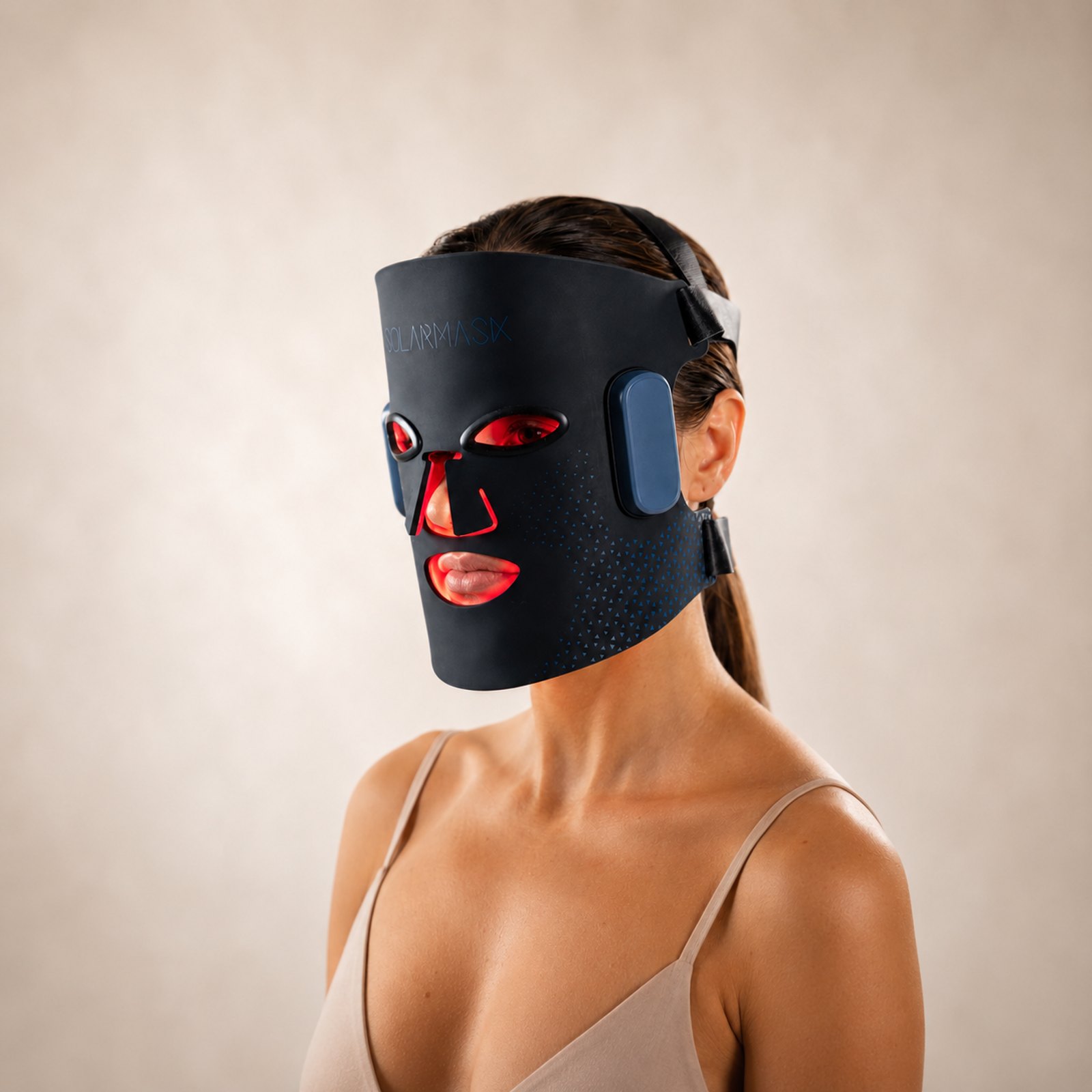
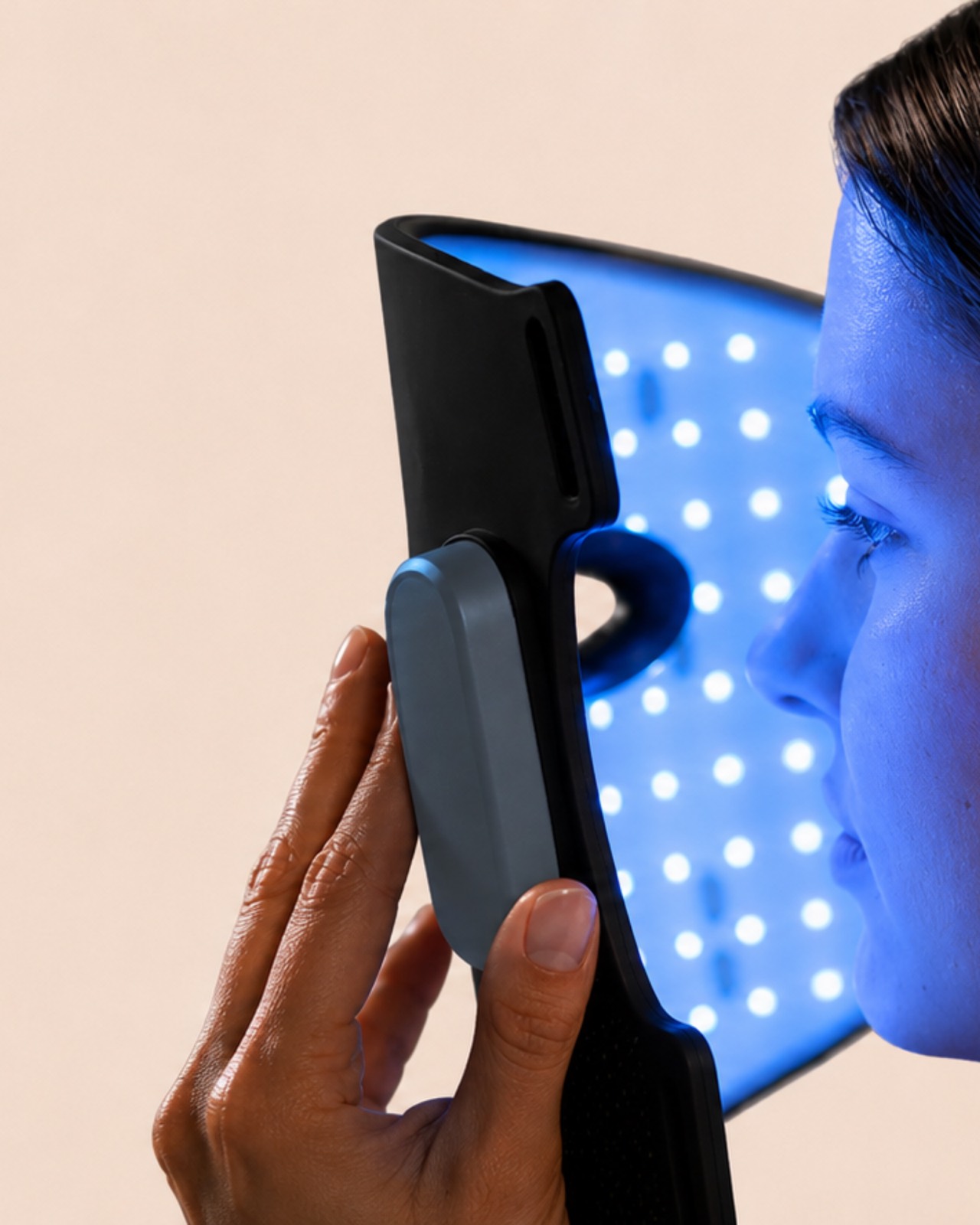
A well-specified at-home mask today, like the SolarMask, features 312 LEDs across five wavelengths — red (630 nm), blue (450 nm), yellow (580 nm), near-infrared (850 nm), and a purple combination mode that activates red and blue simultaneously. That's a genuinely comprehensive range. With a home device, you have the flexibility to switch between modes based on what your skin feels like that week. For a deeper look at how these wavelengths behave, LED Mask Scientific Research: What Does the Evidence Actually Say? is a useful starting point.
What salons do have in their favour is sheer output power. Professional devices can operate at higher irradiance levels. That said, a well-engineered home device compensates by being used more frequently — and consistency, as we'll see, is arguably the more important variable.
2. Consistency: The Factor That Changes Everything
This is where at-home LED therapy genuinely has a structural advantage. A typical salon course of LED treatment might involve weekly or fortnightly appointments — partly because of scheduling, partly because of cost. An at-home device can be used 3–5 times per week during the first four to six weeks, and then 1–2 times per week for ongoing maintenance. Each session is exactly 15 minutes, with an automatic timer that stops the device.
Light therapy — whether red, blue, yellow, or near-infrared — works cumulatively. Skin doesn't transform after a single session. The research on photobiomodulation consistently points to regular, repeated exposure as the mechanism through which visible changes build up over time. Many users find that a home device used diligently across four to six weeks supports their skincare routine more continuously than a handful of salon visits over the same period.
The critical word here is 'used diligently'. Results vary from person to person, and a home device that sits in a drawer delivers exactly nothing. The convenience of having it at home removes the single biggest barrier to consistency: having to book, travel, and pay for each appointment separately.
3. Wavelengths and What Each Mode Is Actually For
Whether you're in a salon or at home, the logic of LED therapy follows the same principles. Different wavelengths of light interact with the skin at different depths and are associated with different visible effects:
- Red (630 nm): associated with a smoother-looking complexion and less visible fine lines.
- Blue (450 nm): works at the skin's surface and is linked to calmer-looking skin and less visible blemishes.
- Yellow (580 nm): associated with a fresher, more even-looking skin tone.
- Near-infrared (850 nm): penetrates deepest and is linked to general skin vitality.
- Purple: the combination mode — red and blue active simultaneously, not a separate wavelength.
Salons will typically select one or two of these modes per session based on a brief consultation. With an at-home device, you make that choice yourself — which sounds more complex, but in practice is straightforward once you understand which mode is associated with which visible outcome. The SolarMask FAQ covers this in plain language if you want a quick reference.
Cost, Convenience, and the Longer-Term Picture
Professional LED facials in salons typically require repeated appointments, and costs add up quickly over a recommended course of sessions. The SolarMask is priced at €199 — a one-time investment that covers unlimited sessions and comes with a two-year warranty on the device itself.
That cost difference matters less if you only intend to try LED therapy once. But if you're thinking about long-term skin maintenance — which is where this kind of light therapy genuinely makes sense — the economics of an at-home device are straightforwardly better. For a detailed breakdown of what to weigh up when comparing home and salon options, see Are At-Home LED Masks Worth It Compared with Salon LED Treatments?.
There is one area where salons hold a genuine edge: professional oversight. If you have a specific skin concern, a dermatologist or trained aesthetician can guide your treatment plan in a way that a home device cannot. This is worth acknowledging honestly. If you're using light therapy as part of a general skincare routine — for a radiant complexion, more even-looking skin tone, or smoother-looking skin — a home device is well-suited to that goal. If you have an active skin condition, a diagnosed concern, or if you're pregnant, breastfeeding, or on light-sensitive medication, always speak to a doctor before starting any LED therapy, at home or in a salon.
What 'Effective' Actually Means Here
It's worth being precise about the word 'effective'. LED light therapy — at home or in a salon — supports cosmetic skin care. It is not a medical treatment, and no responsible device or clinic should position it as one. The SolarMask is a CE-certified cosmetic device with no UV output; it is not a medical instrument.
What users of regular LED therapy — both in salons and at home — consistently report is a gradual improvement in how their skin looks and feels: fresher, more even, smoother-looking over time. Results differ between individuals, and it's worth committing to at least four weeks of consistent use before forming a view. That applies whether you're going to a salon weekly or using a home mask four times a week.
- Salon LED devices often have higher output power; at-home masks compensate through more frequent, consistent use.
- Regular use — 3–5× per week for the first 4–6 weeks — supports a consistent cosmetic skincare routine; results vary between individuals.
- The SolarMask offers five wavelength modes, giving you the flexibility to switch between them across sessions.
- The one-time cost of a home device (€199) is significantly lower than a full course of salon appointments.
- Salon treatments offer professional oversight — valuable if you have specific skin concerns or conditions.
- Results vary between individuals; allow at least 4 weeks of regular use for a fair assessment.
- At-home LED therapy does not replace medical advice; consult a doctor if in doubt.
Frequently asked questions
Is at-home LED light therapy as effective as a salon treatment?+
It can be, depending on how consistently you use it. Salon devices often have higher power output per session, but at-home devices used regularly — 3–5 times per week during the first 4–6 weeks — give you continuous access to your skincare routine in a way that individual salon visits may not. Results vary between individuals.
How long is each SolarMask session?+
Exactly 15 minutes. The device has an automatic timer and switches off at the end of each session.
Can I use all five wavelengths in one session?+
No — you select one mode per session. Each mode corresponds to a specific wavelength and visible skin outcome. You can vary which mode you use across different sessions during the week.
Is the SolarMask safe to use at home without professional supervision?+
The SolarMask is a CE-certified cosmetic device that emits no UV radiation. It is designed for home use. That said, if you are pregnant, breastfeeding, on light-sensitive medication, or have an active skin condition, consult a doctor before use.
How soon will I see results?+
Most people notice gradual changes over four to six weeks of consistent use. Results differ between individuals — which is why we recommend committing to at least four weeks before drawing conclusions. Light therapy is cumulative, not instant.
So — is LED light therapy at home as effective as a professional salon treatment? For most people using it as part of a consistent cosmetic skincare routine, an at-home device holds up very well. The technology has matured, the wavelength range is genuinely broad, and having the device at home makes it easier to keep up with a regular schedule. Salons still offer professional guidance that has real value, especially for more complex concerns — but for a visibly fresher, more even-looking complexion over time, a well-specified home device is a compelling choice. If you'd like to see exactly what the SolarMask offers, the full product details are here.
Would you like to give this a go yourself?
The SolarMask LED Mask — all five wavelengths
Professional light therapy for home use. One mask, five treatments, 15 minutes per session. CE-certified.
View the mask →Esmee writes about skincare, LED light therapy and the science behind SolarMask. Any questions? Please email contact@solarmask.eu.
 Recommended by Dr. Farah MacDonald — physician & skin specialist
Sources & scientific studies
- Wunsch A, Matuschka K (2014). A controlled trial to determine the efficacy of red and near-infrared light treatment in patient satisfaction, reduction of fine lines, wrinkles, skin roughness, and intradermal collagen density increase. Photomedicine and Laser Surgery.
- Avci P et al. (2013). Low-level laser (light) therapy (LLLT) in skin: stimulating, healing, restoring. Seminars in Cutaneous Medicine and Surgery.
- Hamblin MR (2017). Mechanisms and mitochondrial redox signaling in photobiomodulation. Photochemistry and Photobiology.
- De Arruda Vidal C et al. (2020). LED phototherapy for facial rejuvenation. Journal of Cosmetic and Laser Therapy.
Medical disclaimer: This article is for informational purposes only and does not constitute medical advice. LED light therapy supports the skin but does not cure conditions; results vary from person to person. If you are pregnant, taking light-sensitive medication or have a skin condition, please consult your doctor first.