Salon LED facials can cost a small fortune per session. At-home LED masks promise the same wavelengths, at a fraction of the price. But are they genuinely worth it — or is it wishful thinking? Here is an honest comparison.
LED light therapy used to be something you could only access in a dermatologist's clinic or a high-end beauty salon. Today, at-home LED masks have become a serious skincare staple — but the question many people ask before buying is a fair one: are at-home LED masks worth it compared with salon LED treatments? The answer depends on a few key factors: the technology inside the device, how consistently you use it, and what you are actually hoping to achieve. Let us break it down.
Are At-Home LED Masks Worth It Compared with Salon LED Treatments? The Core Differences
The most obvious difference between a salon treatment and an at-home device is the setting — but the more important differences lie in cost, frequency, and the wavelengths on offer.
A single professional LED facial in the UK typically costs anywhere from £60 to £150 per session. Most practitioners recommend an initial course of six to ten sessions, followed by monthly maintenance. Do the maths and you are looking at £500–£1,500 just to complete an introductory programme, before ongoing costs. Meanwhile, a quality at-home LED mask — such as the SolarMask at €169 — is a one-time investment that you can use indefinitely.
That cost difference alone is significant. But value is not only about price. The real question is whether an at-home device can deliver comparable wavelengths, and whether you will actually use it consistently enough to see results.
Wavelengths: What Salon Panels and At-Home Masks Actually Deliver
Professional salon LED panels are often large, powerful devices that cover the full face and neck. They tend to offer one or two wavelengths — most commonly red and near-infrared. Some premium clinics offer blue light as well, but multi-wavelength devices are less common in salon settings than you might expect.
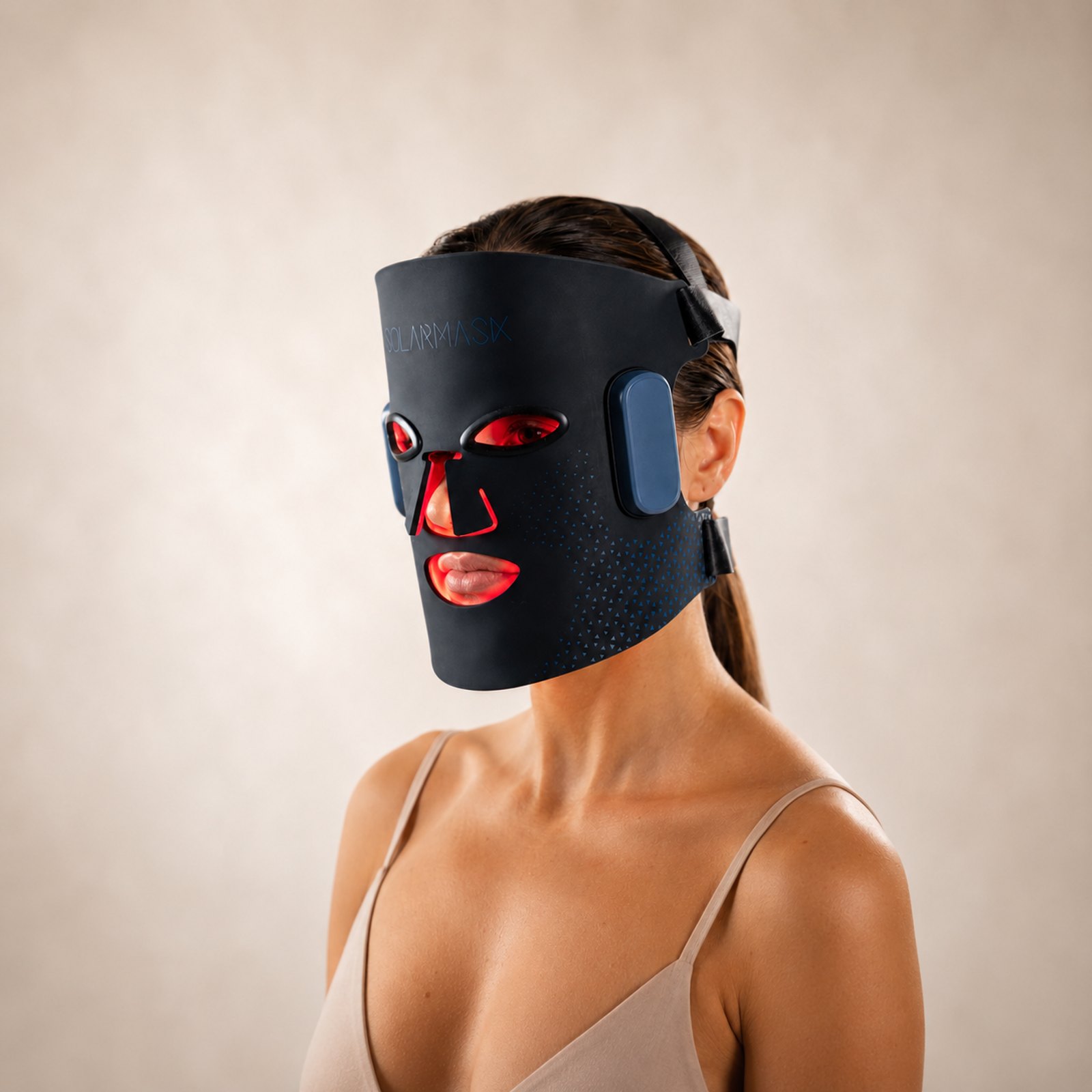
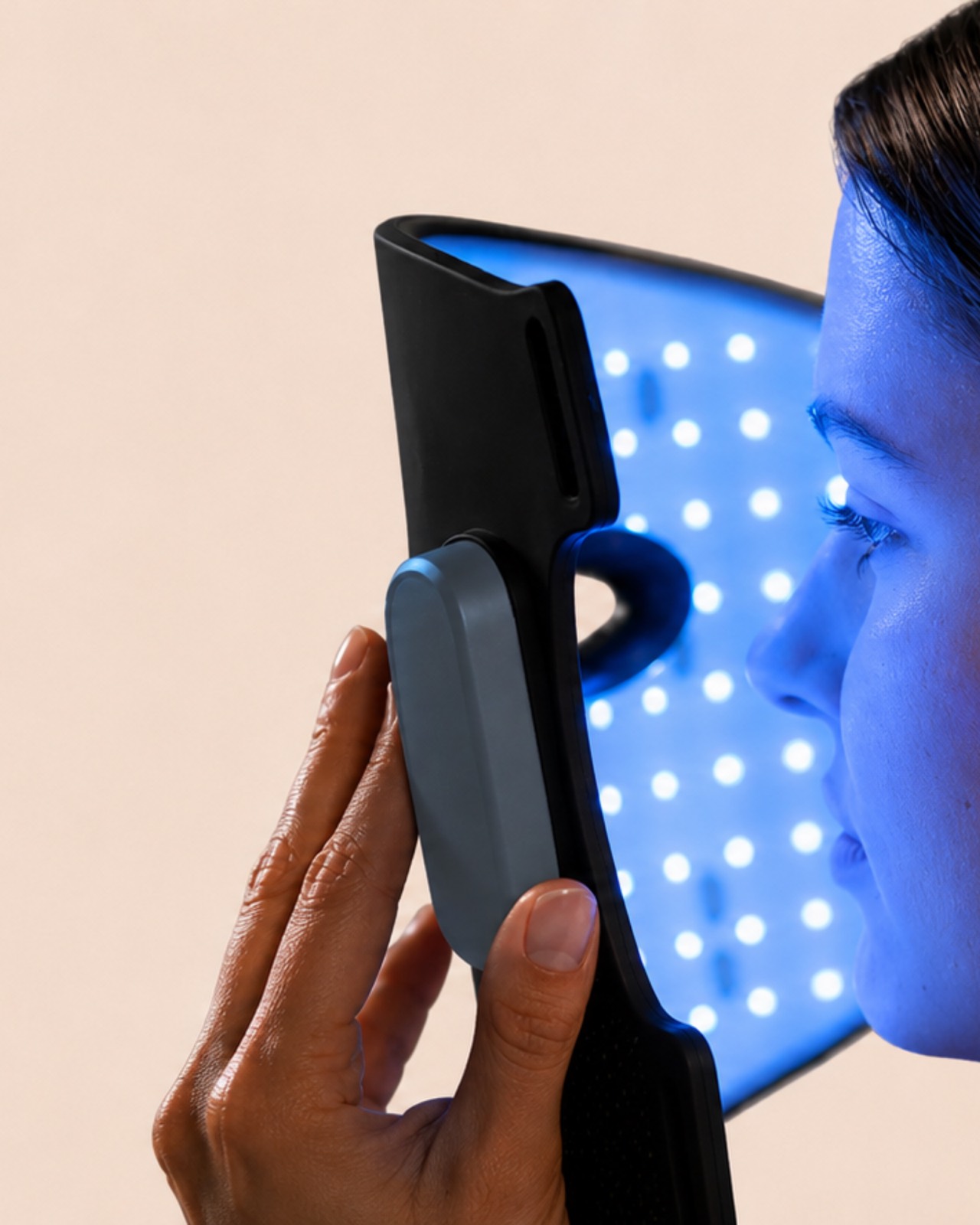
A well-designed at-home LED mask can match — and in some cases exceed — the range of wavelengths available in a salon. The SolarMask, for example, uses 312 LEDs across five distinct light modes: red (630 nm), blue (450 nm), yellow (580 nm), near-infrared (850 nm), and purple — which simultaneously combines red and blue light. Each wavelength is associated with different skin-supportive properties. You can read more about the research behind each in our dedicated guides, such as the science behind red LED light therapy and near-infrared LED light therapy.
The key point: having all five wavelengths in one device means you are not locked into a single treatment goal. A salon session often targets one concern at a time. With SolarMask, you have all five options available at home, whenever you need them.
Consistency: The Factor That Matters Most
Here is something that does not get said often enough: with LED light therapy, frequency matters more than any single session. Research in photobiomodulation — including work by Hamblin (2017) and Wunsch (2014) — suggests that the cumulative effect of regular light exposure is central to what makes LED therapy work. Occasional salon visits, even with powerful equipment, may be less effective than consistent at-home use.
The recommended protocol for the SolarMask is 3–5 sessions per week during the first four to six weeks, then 1–2 sessions per week for ongoing maintenance. Each session lasts exactly 15 minutes — the mask has a built-in automatic timer and switches off by itself. Fitting that into a weekly salon schedule would be expensive and logistically impractical for most people. Fitting it into a Tuesday-evening skincare routine at home is entirely realistic.
For a closer look at how often to use an LED mask and why, see our guide on how often you should use an LED mask.
What Can You Realistically Expect?
Whether you use a salon panel or an at-home mask, managing expectations is important. LED light therapy is not an overnight fix, and results vary from person to person. What many consistent users report — both in salon and at-home settings — includes a visibly brighter complexion, a more even skin tone, a calmer-looking skin, and a generally healthier-looking radiance over time.
What neither a salon treatment nor an at-home mask will do is replace medical treatment for a diagnosed skin condition, or produce the kind of instant, dramatic result that some marketing promises. The science behind light therapy points to gradual, cumulative improvement — which is exactly why consistency at home has a genuine advantage over irregular salon visits.
- Visibly brighter, more luminous-looking skin over time
- A more even and balanced complexion
- Skin that looks calmer and more rested
- Reduced appearance of dullness with regular use
- Results that build gradually — not overnight
Results differ per person, and LED light therapy is not a substitute for medical advice. If you are taking photosensitive medication, are pregnant, or have an active skin condition, please consult a doctor before starting any light therapy routine.
So — Is an At-Home LED Mask Worth It?
For most people who want to integrate LED light therapy into their regular skincare routine, an at-home device offers a compelling combination of value, flexibility, and variety of wavelengths. The one-time cost of the SolarMask (€169) is equivalent to one or two salon sessions, yet it gives you access to five wavelengths and unlimited 15-minute sessions at home — on your schedule.
Salon treatments still have their place — particularly when combined with other professional treatments like chemical peels or microneedling, or when guided by a dermatologist. But as a standalone, regular skincare tool? The at-home LED mask holds its own. Many of our users share their honest experiences on our reviews page.
- A single salon LED session costs £60–£150; SolarMask is a one-time investment of €169.
- At-home masks can match salon wavelength variety — SolarMask offers five: red, blue, yellow, near-infrared, and purple.
- Consistency (3–5× per week, 15-minute sessions) drives results more than any single powerful session.
- Results are gradual and vary per person — expect a brighter, calmer, more even complexion over time.
- For most people, a quality at-home LED mask offers better long-term value than regular salon visits alone.
Frequently Asked Questions
Are at-home LED masks as powerful as salon LED treatments?+
Professional salon panels are often physically larger, but power is only part of the picture. The wavelengths available, the number of LEDs, and — crucially — how consistently you use the device matter just as much. The SolarMask uses 312 LEDs and five wavelengths, offering a comprehensive at-home option that many users find highly effective when used regularly.
How long does each SolarMask session last?+
Each session lasts exactly 15 minutes. The mask has a built-in automatic timer and switches itself off — no guesswork required.
How often should I use an at-home LED mask to see results?+
For the first four to six weeks, 3–5 sessions per week is recommended. After that, 1–2 sessions per week is sufficient for maintenance. Results build gradually with consistent use.
Is it safe to use an at-home LED mask every week?+
Yes, when used as directed. The SolarMask is CE-certified and emits no UV radiation. If you are taking photosensitive medication, are pregnant, or have an active skin condition, consult your doctor first. For more detail, see our guide on whether LED masks are safe.
What makes the SolarMask different from a single-wavelength device?+
Many at-home LED devices offer only one or two wavelengths. SolarMask gives you five — red (630 nm), blue (450 nm), yellow (580 nm), near-infrared (850 nm), and purple (red + blue combined) — all in one mask, so you can adapt your routine to your skin's needs rather than being limited to a single treatment mode.
The verdict is clear for most skincare enthusiasts: if you want the benefits of LED light therapy without the recurring salon bill, a quality at-home LED mask is genuinely worth the investment — provided you use it consistently. Five wavelengths, 312 LEDs, and a 15-minute automatic session make the SolarMask a practical, long-term addition to any skincare routine. Give your skin the regularity it needs, and let the light do the rest.
Would you like to give this a go yourself?
The SolarMask LED Mask — all five wavelengths
Professional light therapy for home use. One mask, five treatments, 15 minutes per session. CE-certified.
View the mask →Esmee writes about skincare, LED light therapy and the science behind SolarMask. Any questions? Please email contact@solarmask.eu.
 Recommended by Dr. Farah MacDonald — physician & skin specialist
Sources & scientific studies
- Wunsch A, Matuschka K (2014). A controlled trial to determine the efficacy of red and near-infrared light treatment in patient satisfaction, reduction of fine lines, wrinkles, skin roughness, and intradermal collagen density increase. Photomedicine and Laser Surgery.
- Avci P et al. (2013). Low-level laser (light) therapy (LLLT) in skin: stimulating, healing, restoring. Seminars in Cutaneous Medicine and Surgery.
- Hamblin MR (2017). Mechanisms and mitochondrial redox signaling in photobiomodulation. Photochemistry and Photobiology.
- De Arruda Vidal C et al. (2020). LED phototherapy for facial rejuvenation. Journal of Cosmetic and Laser Therapy.
Medical disclaimer: This article is for informational purposes only and does not constitute medical advice. LED light therapy supports the skin but does not cure conditions; results vary from person to person. If you are pregnant, taking light-sensitive medication or have a skin condition, please consult your doctor first.